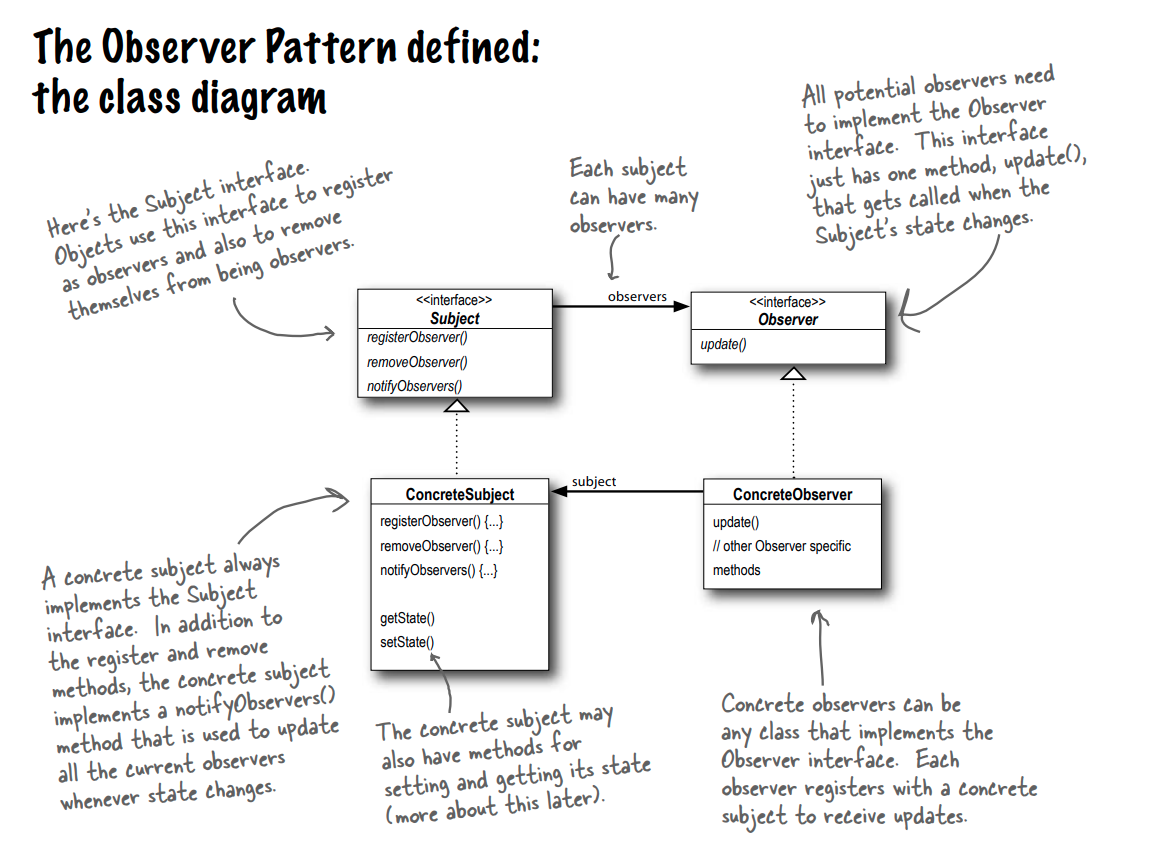
Observer is a behavioral design pattern that allows some objects to notify other objects about changes in their state.
This pattern allows an instance (called subject) to publish events to other multiple instances (called observers). These observers subscribe to the subject and hence get notified by events in case of any change happening in the subject.
The Observer Pattern defines a one-to-many dependency between objects so that when one object changes state, all its dependents are notified and updated automatically.
The power of Loose Coupling
Strive for loosely coupled designs between objects that interact.
- When two objects are loosely coupled, they can interact, but have very little knowledge of each other.
- The Observer Pattern provides an object design where subjects and observers are loosely coupled.
Why?
- The only thing the subject knows about an observer is that it implements a certain interface (the Observer interface). It doesn’t need to know the concrete class of the observer, what it does, or anything else about it.
- We can add new observers at any time. Because the only thing the subject depends on is a list of objects that implement the Observer interface, we can add new observers whenever we want. In fact, we can replace any observer at runtime with another observer and the subject will keep purring along. Likewise, we can remove observers at any time.
- We never need to modify the subject to add new types of observers. Let’s say we have a new concrete class come along that needs to be an observer. We don’t need to make any changes to the subject to accommodate the new class type, all we have to do is implement the Observer interface in the new class and register as an observer. The subject doesn’t care; it will deliver notifications to any object that implements the Observer interface.
- We can reuse subjects or observers independently of each other. If we have another use for a subject or an observer, we can easily reuse them because the two aren’t tightly coupled.
- Changes to either the subject or an observer will not affect the other. Because the two are loosely coupled, we are free to make changes to either, as long as the objects still meet their obligations to implement the subject or observer interfaces.